I chose to conduct my textual analysis on The Odyssey by Homer because it is freely available on Project Gutenberg and I have some familiarity with the text. By using technology to process this text, I explored the affordances and limitations of digital textual analysis.
First, I put the text into Voyant to see if there were any interesting visualizations. I messed around with the settings to add some additional stopwords (like “said”) and then looked at the word cloud produced by the text. This word cloud shows the words that appeared the most throughout The Odyssey.

I had two main observations from this word cloud. First, there is a focus on the idea of home with words like “house” and “home” both holding prominent positions in the cloud. This reflects the focus of the epic on Ulysses’ journey getting back to his home in Ithaca after the Trojan War. Second, the cloud is overwhelmingly masculine with words including “Ulysses,” “Telemachus,” “men,” “man,” “suitor,” “son,” and “father.” This makes sense because most of the prominent characters in the book are men, but it was still surprising to see so clearly in the word cloud. I think this word cloud does a pretty good job of representing some themes of the epic.
Second, I followed these instructions from Anastasia Salter to run the text through Gemini. After pre-processing the text, I ran the following prompt.
Can you visualize the top 30 words as a word cloud?
This was Gemini’s response:
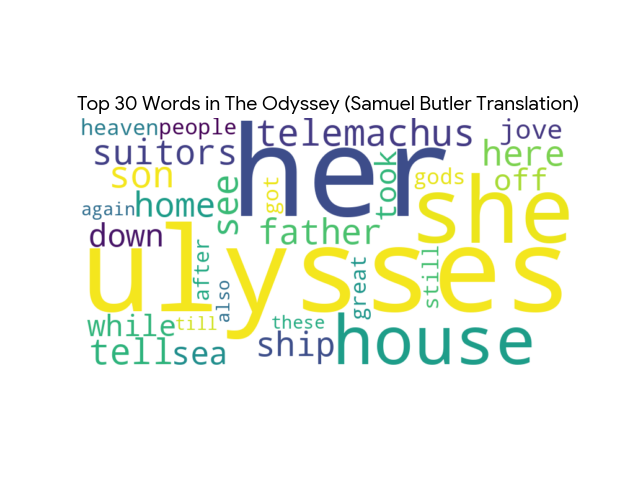
Gemini noted in its response:
To create a meaningful “distant reading” visualization, I filtered out common English functional words (like the, and, he) and general narrative verbs (like said, went, came). This allows the thematic and character-driven core of the epic to stand out.
This was really funny to me because Gemini’s word cloud ended up showing an opposite pattern to Voyant’s, with “her” and “she” being some of the most prominent words. It seems like Gemini caught “he” but not “she,” which is a strange oversight. If I blindly trusted Gemini, I would be led astray. Aside from this issue, Gemini gave me quick and useful responses, creating a co-occurance network, pulling out major themes, and analyzing phrase frequency.
Overall, I see many possible uses for digital textual analysis and found both Voyant and Gemini to be helpful tools. In this “Age of AI,” the main concern I have is blindly trusting the tools to do the work and not checking on them. Gemini and other LLMs frequently make mistakes, so we need to use our judgement before accepting their analyses. Likewise, with Voyant, we need to check in on the context of words–frequency doesn’t always give us a full picture.
As someone who loves greek mythology, this was awesome to see. Its really interesting that AI had the word her as one of the main ones, pretty ironic for the book that just has men. I really wonder if AI was trying to make a broader point about gender and inclusion, and formatted it in the image, or if it was just a processing error. I completely agree that we as a society have already built a very large reliance on AI, and use it almost blind.
I made a similar statement at the end of my assignment regarding the validity of the information AI outputs. We look at generative AI and LLMs as these all-knowing tools when it is nowhere near perfect. Computational tools are great for interpretation of data as long as human interpretation is still present.